Blockchain Explained in Depth: What It Really Is, How It Works, and Why It Matters
Blockchain is one of the most talked-about technologies of the 21st century, yet it remains widely misunderstood. To some, it is synonymous with cryptocurrency speculation. To others, it is a revolutionary system capable of transforming finance, governance, identity, supply chains, art, and even the way humans coordinate trust at a global scale.
This article aims to strip away hype and confusion and explain what blockchain actually is, how it works at a technical and conceptual level, why it was created, and what problems it solves. We will move step by step—from first principles to advanced mechanisms—so that by the end, you will not only understand blockchain, but also be able to reason about its strengths, limitations, and real-world impact.
1. The Core Problem Blockchain Was Designed to Solve
To understand blockchain, you must first understand the problem of trust in digital systems.
1.1 Trust in Traditional Systems
In most modern systems, trust is handled by central authorities:
Banks verify balances and transactions
Governments maintain land registries
Corporations store identity and user data
Platforms control digital ownership
If you send money via a bank, you trust the bank to:
Keep accurate records
Not alter history
Not block or reverse transactions arbitrarily
This model has worked reasonably well—but it has structural weaknesses:
Single points of failure
Corruption or manipulation
Censorship
High costs and inefficiencies
Limited access for billions of people
1.2 The Digital Double-Spending Problem
In the digital world, information is easy to copy.
If I send you a photo, I still have it.
If I send you a file, I can send the same file again.
But money cannot work like that. If digital money can be copied, it becomes worthless.
Historically, the solution was simple: a central ledger maintained by a trusted institution.
Blockchain proposes something radical:
What if we could maintain a shared, tamper-resistant ledger without trusting any single authority?
2. What Blockchain Actually Is (In Plain Terms)
At its core, a blockchain is:
A distributed, append-only database that is shared across many independent computers and secured by cryptography and economic incentives.
Let’s break that down.
2.1 A Ledger
A blockchain is fundamentally a ledger—a record of transactions or state changes.
Examples:
Transfers of digital currency
Ownership of assets
Execution of agreements (smart contracts)
2.2 Distributed
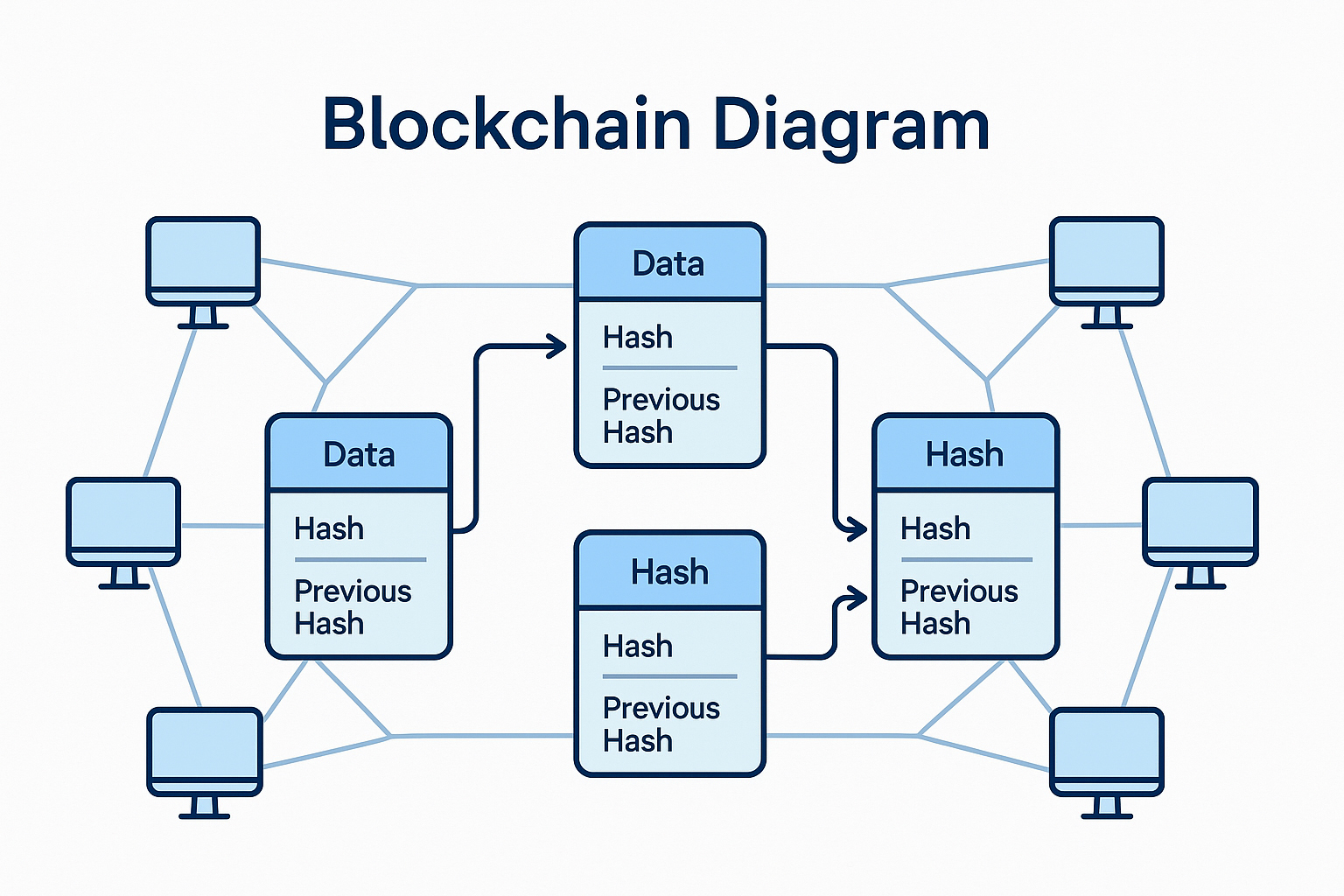
Instead of being stored on one server, the ledger is replicated across many nodes (computers) in a network.
Each node:
Holds a full or partial copy of the blockchain
Independently verifies new data
Communicates with peers
There is no central database to attack or control.
2.3 Append-Only
Data on a blockchain is not edited or deleted.
Instead:
New data is added in blocks
Each block references the previous one
History becomes computationally impractical to change
This creates immutability—not absolute, but economically enforced.
2.4 Cryptographically Secured
Blockchain uses cryptography to ensure:
Authenticity (who signed what)
Integrity (data hasn’t been altered)
Order (which transaction came first)
This is achieved through:
3. Blocks, Chains, and Hashes
3.1 What Is a Block?
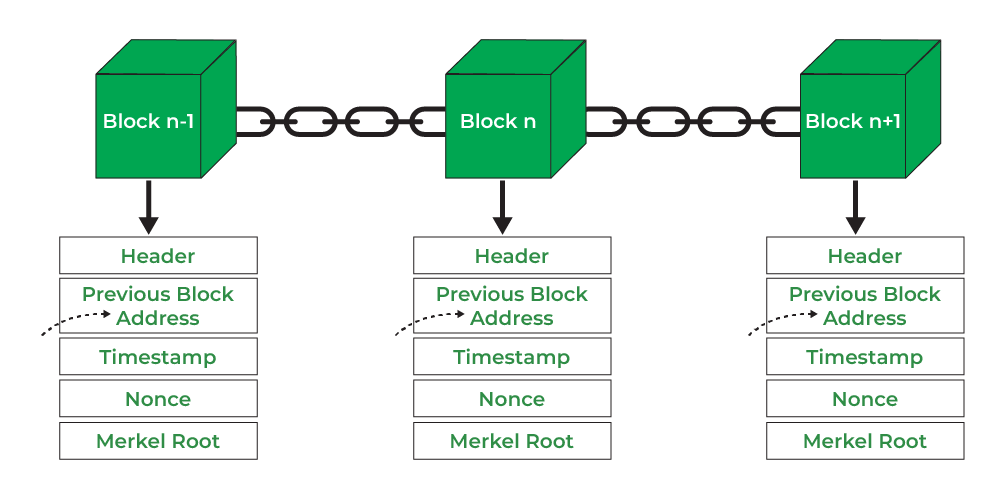
A block is a container of data. Typically, it contains:
A list of transactions
A timestamp
A reference (hash) to the previous block
A cryptographic proof (depending on consensus)
3.2 Hashes: The Glue That Holds It Together

A hash is a fixed-length output generated from input data.
Key properties:
Deterministic
Extremely sensitive to change
One-way (cannot be reversed)
If even a single character in a block changes, its hash changes completely.
3.3 The Chain
Each block includes the hash of the previous block.
This means:
Blocks are mathematically linked
Altering one block would require recalculating all following blocks
On large networks, this becomes infeasible
This is why it’s called a blockchain.
4. Decentralization: More Than Just Many Computers
Decentralization is not binary. It exists on a spectrum.
4.1 Types of Decentralization
Architectural – many physical nodes
Political – many independent owners
Logical – no single point of control
A system can be distributed but still centralized in control.
Blockchain aims for all three forms.
4.2 Why Decentralization Matters
Decentralization provides:
Censorship resistance
Fault tolerance
Reduced reliance on trust
Global accessibility
No single entity can:
Shut the system down
Rewrite history unilaterally
Freeze assets arbitrarily
5. Consensus: How Blockchains Agree on Reality

If many independent nodes maintain a ledger, how do they agree on what is true?
This is solved by consensus mechanisms.
5.1 The Byzantine Generals Problem
In distributed systems, some participants may:
Fail
Lie
Act maliciously
Blockchain consensus mechanisms are designed to tolerate these failures and still reach agreement.
5.2 Proof of Work (PoW)
The first widely successful consensus mechanism.
Key idea:
Nodes (miners) compete to solve cryptographic puzzles
Solving the puzzle gives the right to add a new block
The puzzle is costly to solve but easy to verify
Security comes from economic cost.
Changing history would require enormous computational power.
This mechanism underpins Bitcoin.
5.3 Proof of Stake (PoS)
An alternative that replaces computation with economic stake.
Validators:
Lock up (stake) tokens
Propose and validate blocks
Lose stake if they act dishonestly
Security comes from financial risk rather than energy expenditure.
This model is used by Ethereum after its transition to PoS.
5.4 Other Consensus Models
Delegated Proof of Stake (DPoS)
Practical Byzantine Fault Tolerance (PBFT)
Proof of Authority
Hybrid systems
Each represents different trade-offs between decentralization, speed, and security.
6. Cryptography: The Mathematical Backbone
Blockchain is not magic—it is applied cryptography.
6.1 Public-Key Cryptography
Each user controls:
A private key (secret)
A public key (shared)
Transactions are signed with the private key and verified with the public key.
This enables:
Self-custody
Permissionless participation
Non-repudiation
6.2 Digital Signatures
Digital signatures ensure:
Authenticity (who sent it)
Integrity (unchanged data)
No central authority is required to verify identity.
6.3 Merkle Trees
Merkle trees allow:
Efficient verification of large datasets
Proof that a transaction exists in a block
Lightweight clients (SPV)
They dramatically reduce computational overhead.
7. Transactions: From Creation to Finality
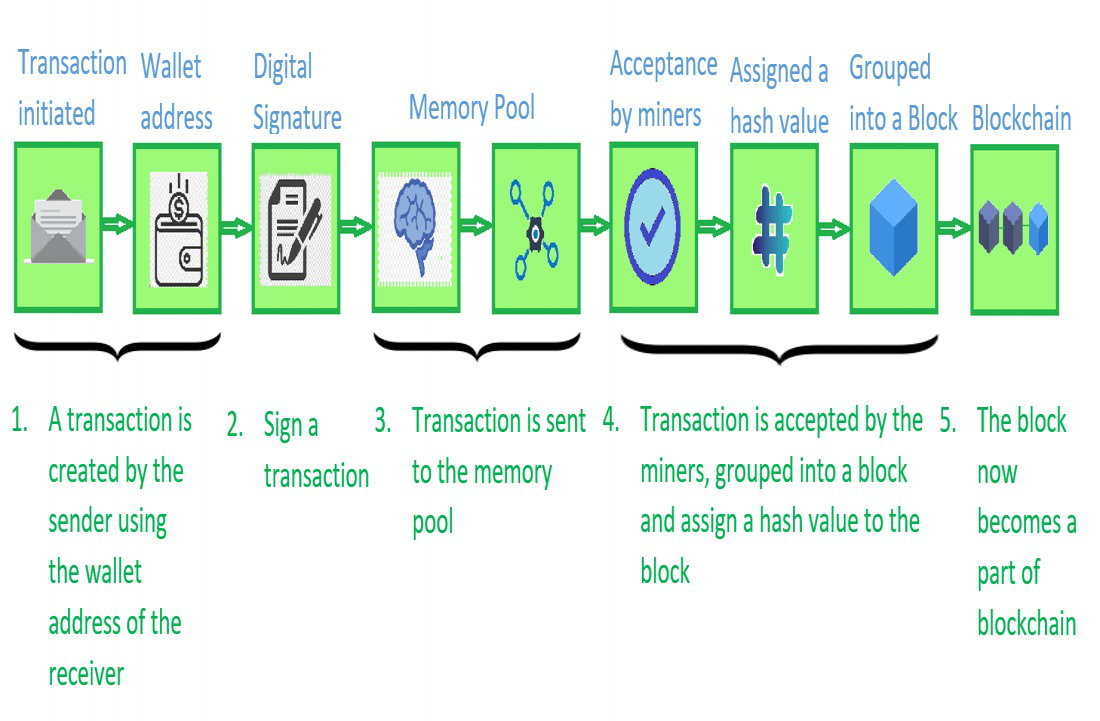
Let’s follow a transaction step by step.
7.1 Transaction Creation
A user:
Constructs a transaction
Signs it with their private key
7.2 Broadcasting
The transaction is broadcast to the network and enters a mempool (waiting area).
7.3 Validation
Nodes verify:
Signature validity
Sufficient balance or state
Compliance with protocol rules
7.4 Block Inclusion
A validator or miner includes the transaction in a block.
7.5 Confirmation and Finality
Once included:
Additional blocks increase confidence
Some systems provide probabilistic finality
Others offer deterministic finality
8. Smart Contracts: Code as Law
One of blockchain’s most transformative features is smart contracts.
8.1 What Is a Smart Contract?
A smart contract is:
A self-executing program stored on the blockchain that runs when predefined conditions are met.
It is:
Deterministic
Transparent
Tamper-resistant
8.2 What Smart Contracts Enable
Decentralized exchanges
Lending and borrowing protocols
NFTs and digital ownership
DAOs (Decentralized Autonomous Organizations)
Automated insurance and escrow
8.3 Limitations
Smart contracts are:
Only as good as their code
Difficult to upgrade
Vulnerable to bugs
They enforce rules, not intent.
9. Tokenization and Digital Assets
Blockchain enables the creation of native digital assets.
9.1 Fungible Tokens
Identical and interchangeable:
Cryptocurrencies
Stablecoins
Utility tokens
9.2 Non-Fungible Tokens (NFTs)
Unique and non-interchangeable:
Digital art
Collectibles
Identity credentials
Intellectual property
9.3 Token Standards
Standardization allows:
Interoperability
Tooling
Ecosystem growth
10. Blockchain Trilemma
Blockchain systems face a fundamental trade-off:
Decentralization
Security
Scalability
Improving one often weakens another.
10.1 Scaling Solutions
Layer 2 networks
Sidechains
Rollups
Sharding
Each attempts to balance the trilemma differently.
11. Public vs Private Blockchains
11.1 Public (Permissionless)
Anyone can participate
Highly decentralized
Censorship resistant
11.2 Private (Permissioned)
Controlled participation
Faster and cheaper
Less trustless
Used mainly in enterprise contexts.
12. Real-World Use Cases Beyond Cryptocurrency
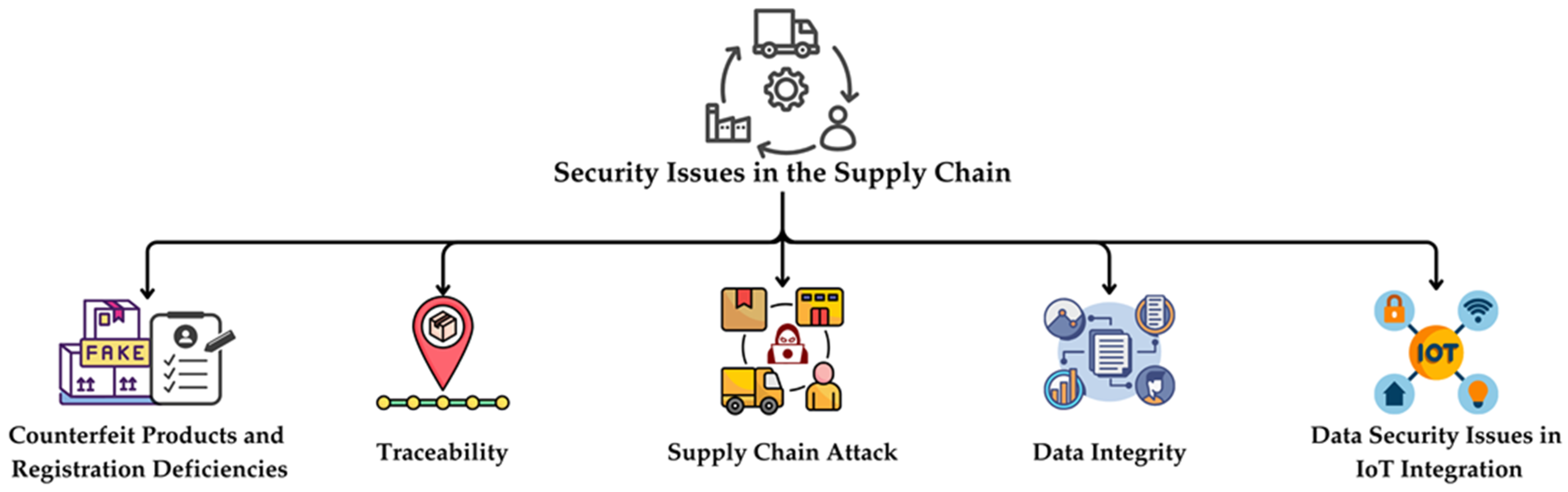
Supply chain tracking
Digital identity
Voting systems
Healthcare records
Cross-border payments
Decentralized finance (DeFi)
Not all use cases require blockchain—but some are uniquely enabled by it.
13. Limitations and Criticisms
Blockchain is not a silver bullet.
13.1 Technical Challenges
Scalability
Energy consumption (PoW)
Complexity
13.2 Social and Regulatory Issues
User error and self-custody risk
Legal uncertainty
Governance disputes
Understanding blockchain requires separating potential from reality.
14. Why Blockchain Matters (Even If You Never Use Crypto)
Blockchain introduces a new paradigm:
Trust minimized, verification maximized.
It allows:
Ownership without intermediaries
Coordination without central control
Systems that outlive their creators
Even if specific projects fail, the ideas behind blockchain—cryptographic trust, decentralized consensus, programmable value—are likely to shape future systems.
15. The Bigger Picture
Blockchain is not just a technology. It is:
A new economic layer
A coordination protocol
A philosophical challenge to centralized power
Like the internet in its early days, its most important applications may not yet exist.
Understanding blockchain today is not about predicting prices—it is about understanding how digital trust can be re-engineered.
Final Thought
Blockchain replaces institutional trust with verifiable truth, enforced by math, incentives, and open participation. Whether it becomes infrastructure as fundamental as the internet or remains a specialized tool will depend not only on technology—but on how humans choose to use it.
If you understand blockchain at this level, you are already ahead of most of the world.
Comments
Post a Comment